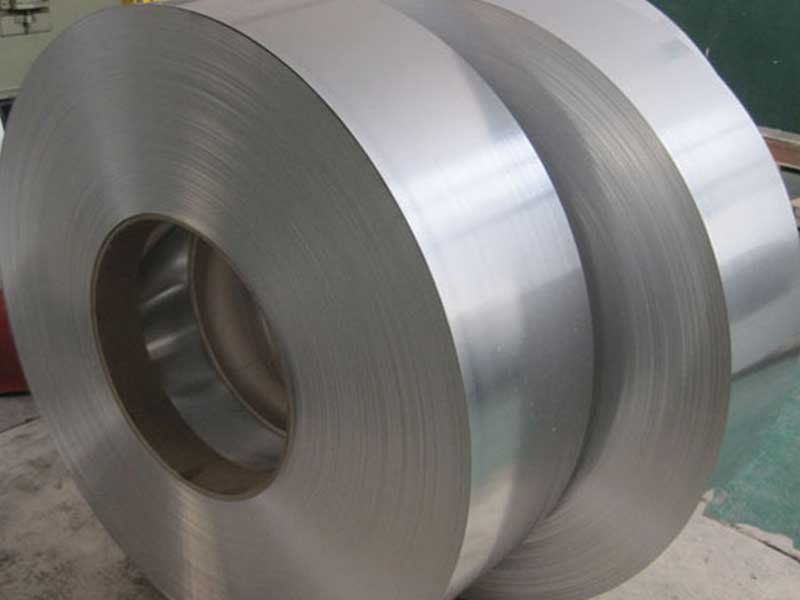
1xxx 8xxx Thin Aluminum Coil Strip
Thin aluminum coil strip in the 1xxx and 8xxx families often gets described in generic terms-"high purity," "good formability," "foil-grade," "battery-grade." That language is accurate, but it misses what makes these materials truly valuable in real production. Their advantage is not just that they are "soft" or "conductive," but that they behave predictably when thickness becomes the design itself. When you are working at 0.20 mm, 0.10 mm, or far thinner in downstream foil conversion, every micro-variation in chemistry, temper, surface condition, and residual stress becomes amplified. In that regime, 1xxx and 8xxx thin coil strip are less like "metal stock" and more like engineered process media-materials chosen as much for how they run as for what they are.
Why "thin" changes the engineering conversation
At thicker gauges, mechanical strength and static properties dominate selection. With thin coil strip, the factory becomes part of the material system. You start evaluating alloys through questions such as: Will it track straight through a high-speed laminator? Will it slit without edge wave? Will it survive tight-radius bending without pinholes? Will it accept a conversion coating evenly, then bond reliably under heat and pressure?
1xxx and 8xxx alloys answer these questions differently. The 1xxx series behaves like a purity-driven conductor and reflector, while 8xxx behaves like a controlled-compromise alloy family that trades a bit of conductivity for better high-speed stability, elevated-temperature performance, and strength. In other words, 1xxx is the "signal clarity" material; 8xxx is the "production robustness" material. Many applications use both-sometimes in adjacent layers-because modern products need electrical performance and manufacturing resilience at once.
Chemical composition: purity versus purposeful alloying
In thin strip, chemistry is not merely an ASTM label; it sets the ceiling for conductivity, the baseline for corrosion response, and the way the strip work-hardens.
Below is a practical composition snapshot for common representatives used in thin coil strip and foil/fin/battery chains. Values vary by standard and supplier practice; typical ranges are shown for engineering comparison.
| Alloy | Main intent | Si (%) | Fe (%) | Cu (%) | Mn (%) | Mg (%) | Zn (%) | Ti (%) | Other notes |
|---|---|---|---|---|---|---|---|---|---|
| 1050/1050A | high purity, high conductivity | ≤0.25 | ≤0.40 | ≤0.05 | ≤0.05 | ≤0.05 | ≤0.05 | ≤0.03 | Al ≥99.50% |
| 1060 | higher purity | ≤0.25 | ≤0.35 | ≤0.05 | ≤0.03 | ≤0.03 | ≤0.05 | ≤0.03 | Al ≥99.60% |
| 1070 | very high purity | ≤0.20 | ≤0.25 | ≤0.04 | ≤0.03 | ≤0.03 | ≤0.04 | ≤0.03 | Al ≥99.70% |
| 1100 | forming + corrosion balance | ≤0.95 | ≤0.95 | 0.05–0.20 | ≤0.05 | - | ≤0.10 | - | widely used, tolerant |
| 8011 | foil/fin workhorse | 0.50–0.90 | 0.60–1.00 | ≤0.10 | ≤0.20 | ≤0.05 | ≤0.10 | ≤0.08 | Fe-Si strengthen, stabilize |
| 8079 | foil for deep draw/packaging | ≤0.30 | 1.00–1.30 | ≤0.10 | ≤0.10 | ≤0.05 | ≤0.10 | ≤0.08 | higher Fe for strength |
This table hints at the philosophy: 1xxx minimizes "noise" in the matrix; 8xxx adds controlled Fe/Si to tune strength and process behavior at low thickness. Those Fe-rich intermetallics can look like a negative on paper, but in high-speed rolling and conversion they can improve pinhole resistance and stiffness at gauge, especially for foil-like products.
Temper and thickness: where performance is actually decided
For thin coil strip, temper is a functional setting rather than a mere suffix. The same alloy can perform like a springy web or a drape-like membrane depending on anneal and work hardening. Common tempers include O (fully annealed), H14/H16/H18 (strain hardened), and foil tempers frequently specified by tensile/elongation targets rather than traditional thick-sheet intuition.
Typical coil strip thickness ranges often seen in industry include:
- Thin strip for fins, closures, EMI shielding, and laminates: about 0.05–0.30 mm
- Foil-stock coil for subsequent foil rolling/conversion: about 0.10–0.30 mm as incoming stock, then rolled much thinner downstream
- Battery collector strip (depending on design): often around 0.010–0.030 mm for foil; thicker for certain tabs or stiffened layers
The distinctive point is that temper selection is often driven by web handling and forming mode rather than strength alone. A soft O-temper 1050 can be perfect for deep drawing or embossing, but it may stretch unevenly in long-span tension zones. An H18 8011 can run with excellent tracking and stiffness, but it may crack if the end-user needs aggressive folding or hemming. The best suppliers therefore treat temper as a process agreement: specifying not only hardness, but also residual stress limits, grain size expectations, and coil-set control.
Features that matter in the real world
Electrical and thermal conductivity
If the goal is minimal resistive loss or fast heat spreading, 1xxx alloys are the natural choice. Purity drives conductivity; every extra percent of alloying generally pulls it down. That is why 1050/1060/1070 are common in transformer strip, busbar laminations at thinner gauges, and thermal spreader layers in laminates. In thin coil strip, that conductivity also stabilizes temperature gradients during high-speed processing, which can reduce curl drift.
Formability and "forgiveness"
1100 and 1050 in O temper can absorb forming variability-tool wear, lubrication changes, minor alignment errors-without sudden cracking. That forgiveness is valuable in fin stamping, light draw operations, and decorative or reflective parts where surface continuity is paramount.
Strength at gauge and resistance to pinholes
8xxx alloys, especially 8011 and 8079, are chosen when thinness must still feel "present" in handling. Their Fe-Si intermetallic population contributes to higher strength at a given temper and can improve stability during rolling and conversion. In packaging foil stock, insulation laminates, and some battery-related multilayer structures, that extra robustness reduces edge tearing and pinhole risk.
Surface, cleanliness, and bonding behavior
For applications involving lamination, adhesive bonding, or coating, surface condition can be more decisive than alloy family. Thin strip is commonly specified with degreasing quality, low rolling-oil residue, and controlled roughness. A slightly tailored surface topography can improve adhesive anchoring or coating uniformity, especially on 8xxx foil stock used in pharmaceutical blister and food packaging.
Applications seen through a "process-first" lens
Heat exchanger fins and thermal management layers
Thin strip for fins demands consistent formability, tight thickness tolerance, and excellent thermal conductivity. 1100 and 8011 both appear here, but selection depends on fin geometry and line speed. 1xxx favors peak conductivity and corrosion resistance in benign environments; 8xxx favors stiffness and dimensional stability for dense fin patterns and high-speed stamping. Tempers such as H14–H18 are often used to hold fin shape after forming.
Battery and energy storage components
In lithium-ion systems, aluminum is prominent as current collector foil (cathode side) and as part of tabs or laminated structures. While true collector foil is extremely thin and typically produced via dedicated foil rolling, thin coil strip still plays roles as precursor stock, tab material, and stiffening layers. Here, the distinctive requirement is not just conductivity, but cleanliness, low defect density, and consistent mechanical response under cyclic handling. 1xxx supports conductivity and corrosion behavior; 8xxx supports strength and web integrity, especially where slitting quality and edge condition affect downstream coating uniformity.
Packaging, blister, and insulation laminates
8011 and 8079 dominate foil-related feedstock because converters need a strip that behaves consistently through rolling, annealing, printing, coating, and laminating. The feature is not only barrier performance but also "runability": stable tension, predictable elongation, and low pinhole incidence. In many laminate stacks, the aluminum layer is the quiet hero that provides barrier and dimensional backbone.
EMI shielding, reflective and decorative strip
1xxx alloys are strong candidates for high reflectivity applications and EMI shielding laminates where conductivity is prized. The finish requirements can be strict, and the coil must remain flat after slitting. Annealed tempers are common when the strip must conform to contours or be integrated into tapes.
Implementation standards and quality controls that protect thin-gauge performance
Thin coil strip quality is usually governed by a combination of alloy standards and application-specific agreements. Common references include ASTM B209 (sheet and plate, often adapted for strip), EN 485 (Europe), and GB/T 3880 (China), with additional foil/packaging and battery customer specifications layered on top.
In practice, the most meaningful controls for 1xxx/8xxx thin strip include:
- Thickness and crown tolerances suited to slitting and lamination, not just nominal gauge
- Flatness targets addressing edge wave, center buckle, and coil set
- Surface cleanliness limits, especially for coating/lamination and battery uses
- Edge condition and burr control after slitting, since thin edges are failure initiators
- Mechanical property windows aligned to forming mode, often specified by tensile/elongation rather than hardness alone
- Defect inspection standards for inclusions, scratches, roll marks, and pinholes (when destined for foil conversion)
The distinctive takeaway: choose the "behavior," not only the alloy
1xxx and 8xxx thin aluminum coil strip are not competing options so much as complementary behaviors. When you need the strip to act like a pure pathway for heat or electrons, 1xxx is the cleanest answer. When you need the strip to act like a reliable, high-speed web that resists tearing, holds shape, and tolerates the realities of conversion, 8xxx becomes the production-minded choice. The most successful designs start by defining how the strip must behave through the entire manufacturing journey-rolling, slitting, forming, bonding, coating, and end-use cycling-then selecting alloy and temper as the final, precise tuning.
https://www.alusheets.com/a/1xxx-8xxx-thin-aluminum-coil-strip.html