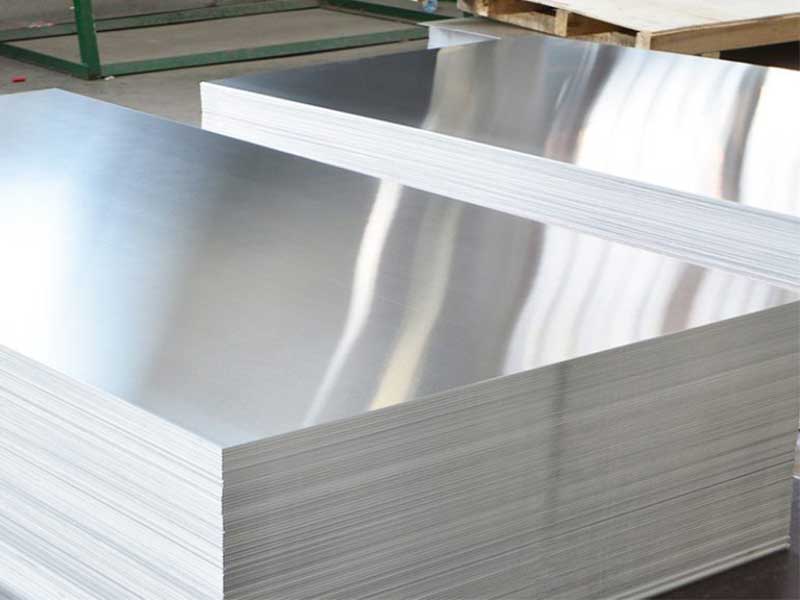
5052 5005 aluminum sheet aluminum plain sheet
5052 and 5005 aluminum sheet are two of the most widely used non-heat-treatable aluminum alloys for plain sheet products. They combine excellent corrosion resistance, attractive appearance after anodizing, and good formability, making them ideal for architectural, marine, and general fabrication uses.
Both 5052 and 5005 belong to the Al-Mg (5000 series) family, but they are tailored for slightly different priorities.
| Item | 5052 Aluminum Sheet | 5005 Aluminum Sheet |
|---|---|---|
| Alloy family | 5xxx (Al–Mg) | 5xxx (Al–Mg) |
| Main strength advantage | Higher strength than 5005 | Moderate strength; excellent anodizing match |
| feature | Superior marine corrosion resistance | Excellent decorative anodizing and color match |
| Typical condition | H32, H34, H38, O | H14, H34, O |
| Main uses | Marine, tanks, truck bodies, pressure parts | Architectural panels, facades, trim, signage |
| Weldability | Excellent | Excellent |
| Formability | Very good | Excellent, especially in softer tempers |
Chemical Composition
Both alloys are primarily aluminum with magnesium as the main alloying element, plus controlled additions of other elements.
5052 Aluminum Sheet – Chemical Composition (Typical)
| Element | Content (wt. %) |
|---|---|
| Mg | 2.2 – 2.8 |
| Cr | 0.15 – 0.35 |
| Si | ≤ 0.25 |
| Fe | ≤ 0.40 |
| Cu | ≤ 0.10 |
| Mn | ≤ 0.10 |
| Zn | ≤ 0.10 |
| Other (each) | ≤ 0.05 |
| Other (total) | ≤ 0.15 |
| Al | Balance |
5005 Aluminum Sheet – Chemical Composition (Typical)
| Element | Content (wt. %) |
|---|---|
| Mg | 0.50 – 1.10 |
| Si | ≤ 0.30 |
| Fe | ≤ 0.70 |
| Cu | ≤ 0.20 |
| Mn | ≤ 0.20 |
| Cr | ≤ 0.10 |
| Zn | ≤ 0.25 |
| Other (each) | ≤ 0.05 |
| Other (total) | ≤ 0.15 |
| Al | Balance |
takeaway:
5052 has a higher magnesium content than 5005, which translates into higher strength and better resistance to chloride-rich environments.
Mechanical & Technical Specifications
Typical Mechanical Properties
Values below are for reference only and depend on thickness and temper.
5052 Aluminum Sheet (Common Tempers)
| Property | 5052-O | 5052-H32 | 5052-H34 |
|---|---|---|---|
| Tensile strength (MPa) | 170 – 215 | 215 – 275 | 230 – 280 |
| Yield strength (MPa, 0.2% proof) | ≥ 65 | ≥ 130 | ≥ 160 |
| Elongation (%) | 18 – 25 | 7 – 14 | 6 – 12 |
| Brinell hardness (HBW) | ~45 | ~60 | ~65 |
5005 Aluminum Sheet (Common Tempers)
| Property | 5005-O | 5005-H14 | 5005-H34 |
|---|---|---|---|
| Tensile strength (MPa) | 110 – 145 | 145 – 185 | 165 – 200 |
| Yield strength (MPa, 0.2% proof) | ≥ 45 | ≥ 110 | ≥ 140 |
| Elongation (%) | 15 – 25 | 5 – 12 | 4 – 10 |
| Brinell hardness (HBW) | ~25 – 35 | ~45 – 55 | ~55 – 60 |
Physical Properties
| Property | 5052 | 5005 |
|---|---|---|
| Density (g/cm³) | ~2.68 | ~2.70 |
| Melting range (°C) | 607 – 650 | 632 – 654 |
| Thermal conductivity (W/m·K) | ~138 | ~201 |
| Electrical conductivity (% IACS) | ~35 | ~52 |
| Coefficient of expansion (20–100 °C, µm/m·K) | ~23.7 | ~23.7 |
Both alloys show good thermal and electrical conductivity typical of non-heat-treatable aluminum, with 5005 offering slightly better conductivity.
Surface, Tolerances, and Available Dimensions
Common Surface Finishes
| Finish Type | Description | Typical Use |
|---|---|---|
| Mill finish | As-rolled surface, light rolling marks | General fabrication, internal parts |
| Brushed / Grained | Uniform directional grain | Decorative panels, interior trim |
| Anodized (5005 focus) | Clear or colored anodic film with uniform tone | Façades, curtain walls, architectural cladding |
| Painted / Coated | PVDF, polyester, or powder-coated surfaces | Outdoor signage, building envelopes, OEM panels |
Typical Thickness & Width Range
Values vary by mill and stock program, but typical commercial ranges are:
| Parameter | 5052 Sheet | 5005 Sheet |
|---|---|---|
| Thickness range | 0.3 – 6.0 mm | 0.3 – 4.0 mm |
| Common widths | 1000 / 1200 / 1250 / 1500 mm | 1000 / 1200 / 1250 / 1500 mm |
| Common lengths | 2000 / 2440 / 2500 / 3000 mm | 2000 / 2440 / 2500 / 3000 mm |
| Custom sizes | Available by order | Available by order |
Flatness & Dimensional Tolerances
Typical tolerances follow standards such as ASTM B209 or EN 485 (actual values vary by specification):
| Parameter | Typical Tolerance Range (Guidance) |
|---|---|
| Thickness | ±0.02 – ±0.08 mm (thin sheet) |
| Width | +2 / –0 mm |
| Length | +3 / –0 mm |
| Diagonal difference | ≤ 5 mm for standard sheets |
Features of 5052 Aluminum Plain Sheet
Performance Highlights
| Feature | Benefit |
|---|---|
| High magnesium content | Higher strength and improved saltwater resistance |
| Excellent corrosion resistance | Suitable for marine and coastal environments |
| Very good weldability | Compatible with MIG/TIG processes and common fillers |
| Good formability | Suitable for bending, deep drawing, and rolling |
| Non-heat-treatable | Strength is controlled by cold work, not heat treat |
Where 5052 Excels
- Marine: hull plating, small boat components, fuel and water tanks, deck hardware
- Transportation: truck and trailer bodies, cargo floors, toolboxes, tankers
- Industrial: pressure vessels (non-critical), chemical storage, pump housings, enclosures
- Consumer products: cabinets, cases, kitchen equipment, refrigeration panels
Its balance of strength and corrosion resistance makes 5052 a natural choice wherever durability in harsh, wet, or salt-rich environments is important.
Features of 5005 Aluminum Plain Sheet
Performance Highlights
| Feature | Benefit |
|---|---|
| Optimized for anodizing | Very good color uniformity and surface consistency |
| Moderate strength, easy to form | Ideal for complex shapes and large cladding panels |
| Excellent corrosion resistance | Suitable for outdoor building applications |
| Good weldability and brazeability | Flexible in fabrication and assembly |
| Close match with 6060/6063 extrusions | Visual consistency between sheets and profiles after anodizing |
Where 5005 Excels
- Architecture and building:
- Curtain walls, façade panels, soffits, roofing, and cladding
- Window trims, sunshades, parapet cappings, column covers
- Signage and display:
- Sign boards, billboards, display panels, totems
- Interior design:
- Ceiling panels, wall linings, decorative strips and trims
- Electrical and engineering:
- Low-voltage enclosures, busbars (where moderate conductivity is acceptable), covers
5005 is usually the first choice when an anodized decorative finish is required and uniform color across large areas is critical.
Comparing 5052 vs 5005 for Your Application
Quick Selection Guide
| Requirement / Priority | Recommended Alloy | Notes |
|---|---|---|
| Maximum corrosion resistance in saltwater | 5052 | Higher Mg content; proven performance in marine use |
| Highest strength between the two | 5052 | Especially in H32/H34 tempers |
| Best decorative anodizing (uniform color) | 5005 | Developed for architectural anodized applications |
| Architectural façade panels | 5005 | Better color match with extrusions |
| Truck bodies / tankers / toolboxes | 5052 | Strong, tough, weldable, corrosion resistant |
| General indoor panels and covers | 5005 | Easy forming and good appearance |
| Deep drawing or complex forming | 5052-O / 5005-O | Select temper based on strength requirement |
Forming & Fabrication
Both 5052 and 5005 can be:
- Sheared, sawn, punched, and drilled with conventional equipment
- Bent with standard press brakes (inside radius should match thickness and temper)
- Welded using MIG or TIG with common filler alloys such as 5356 or 5183 for 5052 and 5005
For demanding forming operations, softer tempers (O, H111) are preferable, while for structural rigidity, H32/H34 (5052) or H14/H34 (5005) are more suitable.
Typical Surface Treatments
| Treatment | Purpose | Suitability |
|---|---|---|
| Anodizing | Corrosion protection, decorative finish | Excellent for 5005, good for 5052 |
| Powder coating | Color, impact resistance, UV resistance | Excellent for both alloys |
| PVDF coating | High-end exterior architectural performance | Widely used on 5005 façade panels |
| Mechanical brushing | Aesthetic grain, hides minor handling marks | Common pre-treatment for architectural use |
For prestigious architectural projects, 5005 anodizing-quality sheet is often specified explicitly to achieve consistent color over large surfaces and between lots.
5052 5005 aluminum sheet aluminum plain sheet products offer a versatile solution for both structural and decorative applications:
- 5052: stronger, more robust in marine and transportation environments, with excellent weldability and corrosion resistance.
- 5005: optimized for architectural and decorative uses, delivering a smooth, consistent anodized appearance with reliable formability.
By matching the alloy to your performance and appearance needs—marine vs architectural, strength vs aesthetic finish—you can achieve durable, lightweight, and visually appealing aluminum components with long service life and efficient fabrication.
https://www.alusheets.com/a/5052-5005-aluminum-sheet-aluminum-plain-sheet.html