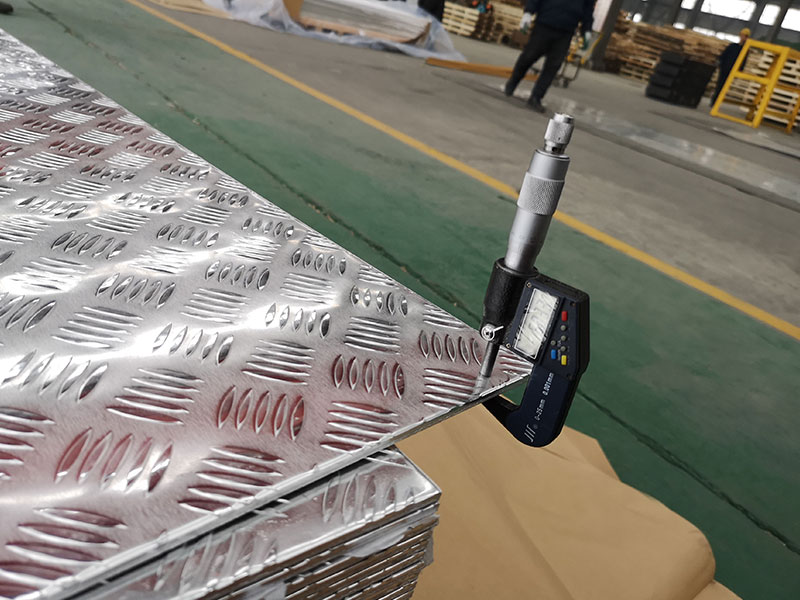
Marine grade aluminum plate 2024 6061 7075
Marine grade aluminum plate 2024 6061 7075
In shipyards and marine workshops around the world, decisions about materials are rarely made at a desk. They are made in the echo of grinders, under salt spray, with welders and engineers asking a practical question: “What happens to this plate after ten years at sea?” When choosing between aluminum alloys 2024, 6061, and 7075 for marine use, the answer is not just in a data sheet; it lives at the intersection of chemistry, environment, fabrication method, and long‑term maintenance.
Instead of asking which alloy is “best,” it is more useful to ask: which alloy is best for a specific marine reality?
Three personalities in the same ocean
Although 2024, 6061, and 7075 are all high‑strength aluminum alloys, they behave almost like three different “characters” once they meet seawater, welding arcs, and dynamic loads.
Aluminum 6061 is the workhorse that quietly does its job. As an Al‑Mg‑Si alloy, it combines decent strength, excellent weldability, and good corrosion resistance, especially when anodized or coated. In the marine world, it shows up in hull structures of small craft, deckhouses, superstructures, gangways, brackets, masts, and platforms. Standards such as ASTM B209 and EN 485 often govern 6061 plate supply, while tempers like 6061‑T6 and 6061‑T651 dominate structural use.
Aluminum 2024 is the aging sprinter. It was designed for high strength and fatigue resistance in aircraft structures, driven by its Al‑Cu‑Mg chemistry. On paper, its yield and tensile strengths are very attractive for marine structures that see cyclical loads. But copper is a double‑edged sword in seawater: it brings strength and takes away corrosion resistance, especially pitting and intergranular corrosion in chloride environments. This makes 2024 suitable only in carefully controlled marine roles, often inland watercraft, sheltered superstructures, or interior structural parts protected by coatings and isolation from direct seawater splash.
Aluminum 7075 is the bodybuilder: the highest strength of the three, capable of matching or exceeding many steels in strength‑to‑weight ratio. Its Al‑Zn‑Mg‑Cu composition, especially in T6 or T651 temper, delivers yield strength. However, like 2024, its copper and zinc content reduce marine corrosion resistance, making it vulnerable to stress corrosion cracking and pitting in chloride environments. As a result, 7075 is rarely used for primary exposed hull structures. Instead, it is chosen for high‑load fittings, mechanical components, or hybrid structures where strength, stiffness, and weight savings justify strict corrosion control and isolation from seawater.
The quiet influence of alloy temper
Most marine disputes about these alloys are not really about the alloy itself, but about the temper.
A plate marked 6061‑T6 has been solution heat treated and artificially aged to maximize strength. Its typical tensile strength lies in the range of roughly 260–310 MPa with yield strength around 240–270 MPa. For shipyards following ABS, DNV, or CCS rules, that strength level is usually more than enough for small craft hulls, superstructures, and secondary structures. The challenge is that welding turns that T6 zone into something closer to an “O” or over‑aged condition in the heat‑affected zone unless post‑weld heat treatment is performed, which is rarely practical on large hull structures. That is why many designers take “as‑welded” properties into account in their scantling calculations and rely on conservative stress levels, additional stiffening, or 5xxx series plates in the most exposed shell areas.
2024‑T3 or T351, with tensile strengths in the 430–480 MPa range, offers remarkable fatigue resistance, which looks tempting for high‑speed hulls and hydrofoil concepts. But again, the temper is vulnerable to corrosion in seawater. Without robust coatings, cathodic protection, and careful joint design, the T3 temper will suffer around fasteners, cut edges, and weld toes. Many marine engineers use 2024 not as a shell material, but in protected load paths: internal frames, joint reinforcement splices, or structural components inside dry compartments.
7075‑T6 and T651 are the heavy hitters. Tensile strengths can push beyond 500 MPa, with yield strengths in the 430–480 MPa range. In a marine‑adjacent application such as high‑performance yacht rigging components, winch drums, structural brackets in dry locations, or subsea tooling that is fully protected, 7075 becomes a strategic weapon: steel‑like stiffness and strength with substantial weight savings. But in direct seawater, the T6 temper is highly sensitive to stress corrosion cracking; for highly loaded components that may see brine or cyclic stress in moist salt air, controlled tempers like T73/T7351 with slightly lower strength but better SCC resistance are sometimes preferred in demanding applications.
Corrosion in seawater: where the story turns
Marine grade aluminum usually means alloys that can survive chloride exposure without “babysitting.” In that strict sense, the strongest choices are often from the 5xxx series, like 5083 or 5086. So where do 2024, 6061, and 7075 fit?
The answer lies in how you manage the environment around the metal.
For 6061, the native oxide film already offers decent protection. Under ISO 12215 for small craft or comparable shipbuilding practices, 6061 plates are often combined with:
- Proper design to avoid crevices that trap stagnant seawater.
- Anodizing or marine‑grade paint systems for splash zones.
- Isolation pads and sleeves when contacting dissimilar metals such as stainless bolts or carbon steel brackets.
For 2024 and 7075, seawater is treated almost as a chemical environment rather than a simple atmosphere. When these alloys are used, experienced designers apply:
- Complete coating systems, including chromate‑free primers and barrier coats.
- Drainage and ventilation paths, so moisture cannot sit and initiate localized corrosion.
- Sacrificial anodes and careful galvanic series management, ensuring they are not directly coupled to more noble metals in wet zones.
- Isolation from direct immersion or constant wetting, often by confining them to interior dry spaces, mastheads, or components above the main splash zone.
In practice, a naval architect might choose 6061 for welded deck structures and rails, with 7075 machined fittings bolted to them using non‑conductive gaskets and sealed fastener holes, ensuring any weak link is the replaceable fitting, not the surrounding structure.
Implementation standards and practical fabrication
Standards form the backbone of marine reliability. For these alloys in plate form, typical references include:
- ASTM B209 for rolled aluminum plate, specifying mechanical properties, permissible deviations, and testing.
- EN 485 series in European supply chains.
- ABS, DNV‑GL, BV, CCS, and LR rules for acceptance of aluminum alloys and welding procedures in marine structures.
- ISO 10042 for weld quality in aluminum structures, relevant where 6061 is extensively welded.
From a fabricator’s viewpoint, 6061 is forgiving. It welds well with standard ER5356 or ER4043 filler wires, responds predictably to bending and forming, and offers decent machinability. Its thermal conductivity also helps dissipate heat during welding, reducing distortion when procedures are well controlled.
2024 and 7075 tell a different story. They are poor choices for heavily welded primary marine structures. Most high‑integrity 7075 and 2024 components in marine environments are machined from plate or forging and bolted or riveted in place, not welded. Any repair philosophy must acknowledge that: you replace the part, not weld it back in place.
Typical chemical composition snapshot
A simplified view of their chemical nature helps explain their behavior in a marine setting. Typical ranges (mass percent) are:
2024:
Cu ~3.8–4.9, Mg ~1.2–1.8, Mn ~0.3–0.9, Fe ≤0.5, Si ≤0.5, Zn ≤0.25, Cr ≤0.1, balance Al.6061:
Mg ~0.8–1.2, Si ~0.4–0.8, Cu ~0.15–0.4, Cr ~0.04–0.35, Fe ≤0.7, Zn ≤0.25, balance Al.7075:
Zn ~5.6–6.1, Mg ~2.1–2.9, Cu ~1.2–2.0, Cr ~0.18–0.28, Fe ≤0.5, Si ≤0.4, balance Al.
The increasing copper and zinc content from 6061 to 2024 to 7075 tracks almost perfectly with increasing strength and decreasing marine corrosion resistance. That trade‑off is not a defect; it is a design parameter.
Choosing the right “marine grade” for your vessel
The most robust way to think about 2024, 6061, and 7075 in marine service is not as rivals, but as a toolkit.
6061 becomes the structural backbone for welded assemblies that see occasional spray, deck loads, and superstructure duties. It works well when paired with correct welding procedures, protective coatings, and sound design to avoid stagnant seawater.
2024 plays the specialist role in fatigue‑critical, protected structures where high cycle life is crucial and seawater exposure is tightly controlled by design and coatings.
7075 is reserved for precision, high‑load components where every kilogram counts and the environment can be engineered: protected locations, sealed housings, or heavily coated and electrically isolated installations.
Marine grade aluminum is not defined solely by alloy designation. It is defined by how intelligently the alloy, temper, fabrication method, environment, and protective system are combined. If 6061, 2024, and 7075 are treated as interchangeable “metal plates,” the sea will expose the mis within a few years. If they are treated as carefully chosen components in a system, each with a clearly defined job and operating envelope, they can deliver decades of safe and efficient service in one of the harshest environments on earth.
https://www.alusheets.com/a/marine-grade-aluminum-plate-2024-6061-7075.html